
nplayer v0.2.0
Iceberg-ready Parquet output, 2.6× faster conversion, and a --jobs default
that sizes itself to the machine.
| Release date | 2026-09-07 |
| Previous | v0.1.0 |
| Requires | Apache Arrow / Parquet 25, zstd, fmt (the dev image) |
Conversion of one day of CME MBO data (47.5M records, 775 MB compressed) drops from 8.4 s to 3.2 s on 8 cores. The full five-day sample converts in 11.5 s with default arguments, down from 46.8 s.
Output schema: Iceberg primitive types
Breaking. Every column now uses a type from the Iceberg primitive set, so the files register in an Iceberg catalog without a cast. pyiceberg's schema conversion rejected the v0.1.0 files on the first timestamp column; it accepts the v0.2.0 files as written.
| Column | v0.1.0 | v0.2.0 | Iceberg |
|---|---|---|---|
ts_recv, ts_event, ts_out | timestamp[ns, UTC] | int64, Unix-epoch nanoseconds | long |
rtype, channel_id, flags, depth | uint8 | int32 | int |
publisher_id | uint16 | int32 | int |
instrument_id, size, sequence | uint32 | int64 | long |
order_id | uint64 | int64 | long |
price | int64 | int64 | long |
ts_in_delta | int32 | int32 | int |
action, side | string | string | string |
Timestamps stay at nanosecond precision. Iceberg's timestamp type holds
microseconds, so the value is stored as a plain integer and the file
metadata gains timestamp_unit = ns. The undefined sentinels still become
nulls. An order_id at or above 2^63 comes out negative; a cast back to
unsigned restores it, and CME ids stay far below that bound.
Column order, encodings, compression, and the dbn.* metadata keys are
unchanged. Row values are identical to v0.1.0 after a type cast; the release
was checked column by column against the previous output over 47.5M rows.
Performance: 2.6× on one file, 4× on the sample set
Measured in the dev container with 8 vCPUs and 7.7 GB on an Apple M4 Pro.

Where the time went
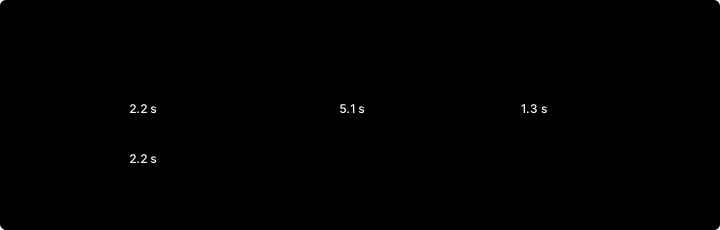
A stage-by-stage benchmark of the decoder thread showed zstd decompression
at 2.1 s and record iteration at 2.2 s, but Arrow column building at 7.3 s.
Five of the eight seconds per file were spent appending values one at a
time through arrow::NumericBuilder::UnsafeAppend, about 107 ns per record
across 14 columns. perf attributed 46% of the decoder thread to that one
function, which GCC keeps out of line, and a further 22% to the append loop
around it.
The writer thread took 7.2 s of CPU for the same file. Compression was 15% of that; Parquet page encoding on a single thread was the rest.
What changed
Columns write straight into reserved buffers. Each batch calls
Reserve, takes the buffer pointer with GetMutableValue, stores values by
index, and closes the batch with UnsafeAdvance. Arrow documents this
sequence for exactly this use. Nullable columns keep a validity bitmap that
starts all valid and clears a bit only on a sentinel, so the common case is
one store. The one-character action and side columns share a single
offsets buffer built once, sliced per batch. Column building fell from 7.3 s
to 2.8 s; the decoder thread is now within 0.6 s of the zstd floor.
Batches encode in parallel. The writer enables
ArrowWriterProperties::set_use_threads, which spreads the columns of a
batch over Arrow's CPU thread pool. Writer-thread time per file fell from
7.2 s to under 1 s of wall clock. Output bytes are unchanged.

--jobs picks itself
--jobs now defaults to 0, which chooses a count at start-up. An explicit
--jobs N behaves as before. The automatic value is the smallest of:
- the number of input files;
- half the CPU cores;
- 60% of the available memory divided by the estimated peak of one
conversion, which is
batch_rows × 80 B × 6 + 64 MB(about 550 MB at the default--batch-rows).
Available memory is MemAvailable from /proc/meminfo, capped by the
cgroup limit minus current usage when one is set (cgroup v2 and v1). When
neither is readable the default is one job. The chosen value is printed as
N files, M at a time.
| Container memory | Chosen jobs (8 cores, 5 files) |
|---|---|
| unlimited (6.7 GB available) | 4 |
--memory 4g | 4 |
--memory 2500m | 2 |
--memory 1200m | 1 |
The core count comes from hardware_concurrency, which ignores a --cpus
quota; pass --jobs explicitly under a CPU quota.
Upgrading
Reconvert existing output. Files written by v0.1.0 carry the old types. Readers that mix versions must handle both.
Cast timestamps on read. The integer is Unix-epoch nanoseconds:
-- DuckDB
select make_timestamp_ns(ts_event) as ts_event from 'day.parquet';
# pyarrow
table.column("ts_event").cast(pa.timestamp("ns", tz="UTC"))
Unsigned readers. Code that read rtype, flags, size, or
sequence as unsigned still works; the values fit. order_id needs a cast
to unsigned only for ids at or above 2^63.
Scripts that relied on --jobs 1. Pass --jobs 1 explicitly to keep
serial conversion, for instance on a shared host.
Known issues
- Symlinked input files escape the output tree.
convert_treeresolves symlinks when it computes the output path, so a symlink under--inputwrites its Parquet file beside the link target. Use real files or bind mounts. - README not yet updated. The Output section and the
--jobsdefault in the README describe v0.1.0.
How it was measured
- Baseline: per-thread CPU time and peak RSS sampled from
/procwhile converting one file. - Stage benchmark: the same file through zstd only, decode only, decode plus column building, and the full writer, each timed alone.
- perf: flat and call-graph profiles of the real binary and of a
frame-pointer build, taken in a privileged container with
linux-tools-6.8.0-117-generic. - Encoder experiment: 12M rows written under each compression codec,
with and without dictionaries and statistics, and with and without
use_threads. zstd level 1 is Arrow's default; lz4 and snappy were 10% faster and 30% larger;use_threadsalone was 4× faster with identical bytes. - Correctness: pyarrow column-by-column comparison against the v0.1.0 output at nanosecond precision, and pyiceberg schema conversion of every output file.
Comments
Sign in to join the discussion.
No comments yet. Be the first.