
NQ Lake 0.1.0
First release of the backend API, with the stack changes that came with it.
Backend API
make up starts a FastAPI backend on the host next to the compose stack;
make down stops both. The API manages Iceberg tables through the Lakekeeper
REST catalog with PyIceberg and answers SQL with DuckDB. /docs holds the
interactive OpenAPI page; the README lists every endpoint.
- Namespaces and tables: list, create, describe, alter (rename, properties, added columns), drop.
- Rows: read by Iceberg filter, append as JSON, delete by filter.
- Parquet upload into an existing table or, when the table is missing, into a
new table built from the file's schema.
/parquet/inspectshows what an upload would do without writing. /queryruns read-only SQL with DuckDB over the whole catalog./statusprobes Lakekeeper, MinIO, Postgres, the catalog, and DuckDB.
Every table the API creates uses Iceberg format version 2. PyIceberg 0.12 reads version 3 but writes only version 2 manifests, so a version 3 table could be created and never filled.
Parquet types Iceberg lacks
An upload repairs what it can and reports every repair in the response;
anything else is rejected with one problem per column and nothing is written.
Unsigned integers widen, float16 widens, dictionary columns decode, wide
decimals narrow when they fit, non-UTC time zones convert to UTC, large and
fixed-size lists become lists. Nanosecond timestamps and times truncate to
microseconds and are flagged lossy. Duration and interval columns, decimals
above 38 digits, typeless all-null columns, and repeated column names are
rejected.
One DuckDB database per process
/query runs on one DuckDB database per process, opened on the first query
and attached read-only to the catalog. Each request gets its own cursor, so
requests run in parallel and share the attached catalog and DuckDB's file
caches. The alternative, a new database attached per request, paid the
extension load, the catalog handshake, and the first table fetch on every
call.
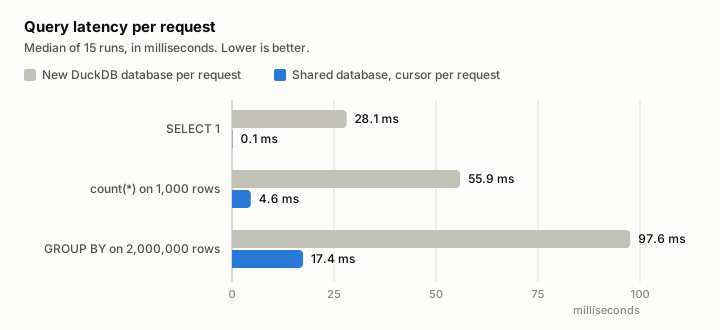
Median of 15 runs on the local stack, measured inside the process, so the
numbers exclude HTTP. Rows appended or deleted through the API are visible to
the next query. A commit that changes only a table's columns shows up in
/query about one second later; GET .../tables/{table} shows it at once.
Stack
- Ports moved to one block: MinIO 40000, console 40001 (reserved, nothing serves it yet), Lakekeeper 40002, Postgres 40003, API 40004. The block stays clear of the usual defaults and of the ephemeral range.
- MinIO's embedded web console is off (
MINIO_BROWSER=off); the lakehouse has its own console. - The init jobs are scripts under
scripts/.minio-init.shcreates the bucket and the non-root user Lakekeeper vends credentials with.lakekeeper-init.shbootstraps the catalog, creates the warehouse when the catalog has none, and points an existing warehouse at MinIO's current port. Both run on everymake up. - The Makefile is
up,down,api,api-start,api-stop,api-logs,ps,logs,clean. Thesmoke,status,ports, andloadtargets are gone with the CLI they called.
Upgrading a checkout
- Copy the port block and
API_PORTfrom.env.exampleinto.env, and removeMINIO_CONSOLE_PORT. - Run
make up. It syncs the Python environment, which now includes FastAPI, uvicorn, python-multipart, and thepyiceberg-coreextra that partition transforms such asday(ts)need on write. The init job moves the existing warehouse to the new MinIO port.
Known limits
/querytakes one statement, without parameters, returns JSON only, and truncates atlimit(at most 10,000 rows) with no cursor for the rest.- Nested Iceberg types can only enter through Parquet upload; the create endpoint takes primitive types.
- No authentication. The API binds to 127.0.0.1 and is meant for the lakehouse's own console.
Comments
Sign in to join the discussion.
No comments yet. Be the first.